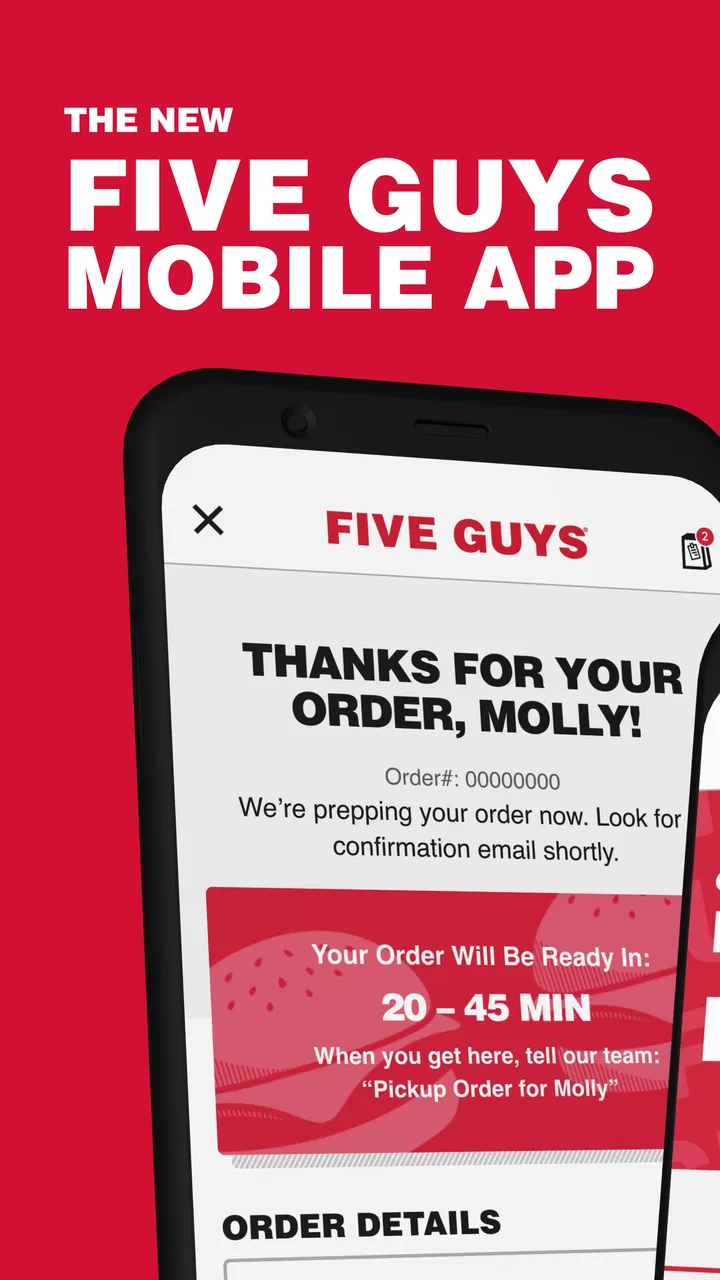
Five Guys Burgers & Fries
- 4.3
- Rating
- 1.00M
- Installs
- Free
- Price

 Analysis by App-foxy
I found Five Guys Burgers & Fries most useful when a meal decision involves more than one person and nobody wants to stand around repeating the order at the counter. It is a free shopping app from Five Guys Franchisor LLC that puts the restaurant’s ordering process on a phone, with the practical focus you would expect: choosing food, preparing an order, and making pickup easier. I would not treat it as a general food-discovery tool. Its value is much narrower, and that is exactly why it can be convenient for the right household.
My first impression was that the app makes the most sense as a shared-meal shortcut rather than something every family member needs to use independently. One person can handle the order while everyone else decides what they want, checks the details, and confirms the final choices. That arrangement reduces duplicated effort, especially when several people want different burger toppings or when a group is ordering fries and drinks along with individual meals.
The app sits in the Shopping category, carries an Everyone age rating, and has reached over a million installs. Its average rating is 4.4 from around twelve thousand ratings, which suggests that many people find the basic ordering purpose worthwhile. I still think the rating should be read in context: a focused restaurant app is judged mainly by how smoothly it handles a hungry person’s short, time-sensitive task, not by how many extra features it offers.
You May Also Like

 Google Keep - Notes and lists
Google Keep’s Quiet Growth Shows the Appeal of Simpler Notes
As mobile work gets busier, Google Keep keeps winning a simple contest: capture a thought quickly, find it later, and get on with the day.

 Blood Strike: 2.5 Anniversary
Blood Strike’s Loadouts Turn Every Drop Into a Tactical Gamble
A close look at Blood Strike’s custom loadouts: how fast access to signature weapons reshapes its battle royale rhythm, rewards preparation, and narrows the gap between fights.

 Pandora - Music & Podcasts
Pandora’s Music Is Easy to Start, but Harder to Recover
Pandora’s strength is its low-effort path from a seed to a station. Its weak spot is how much confidence it asks you to place in connection, setup, and quiet recovery.

 8 Ball Pool
 Is Built on Rivalries, Rematches, and Routine
A close look at the rivalries, rematches, shared routines, and unanswered safety questions that turn a quick pool match into a persistent mobile community.

 Samsung Music
’s Quiet Strength Is Playing What You Already Own
Its reach comes less from spectacle than from dependable access to a personal library. That simplicity is both the app’s strongest retention engine and its ceiling.

 AccuWeather: Weather Radar
AccuWeather Review: A Quick, Clear Forecast for Everyday Decisions
For everyday plans, the best forecast is the one you can understand quickly. AccuWeather makes rain timing, radar, and local conditions easy to act on, with a few trade-offs.
More From Our News Desk



How it works in a shared household
When I use a restaurant-ordering app in a shared household, I find it helps to agree on a simple handoff before anyone starts choosing: one person gathers preferences, and another—or the same person—checks the completed order. That small routine is especially useful when people are in different rooms or have different topping preferences. It keeps the phone from becoming a communal to-do list and makes the next decision about who will place and collect the order much clearer.
One phone can keep a group order under control
A realistic use case is a busy evening when one person is leaving work, another is already at home, and the rest of the household is trying to agree on dinner. Instead of passing around a paper list or sending several messages that later need to be reconciled, I would use one device as the order owner. Each person can state their burger preferences, fry choice, and drink request while the person placing the order enters everything in one sitting.
That sounds simple, but it solves a common problem with restaurant ordering: the person who pays is not always the person who knows everyone’s preferences. With Five Guys, toppings can make a burger order more personal than simply selecting a standard menu item. I recommend reading the completed order aloud before submitting it, particularly when two burgers look similar. A quick verbal check is more reliable than assuming that everyone remembers what they asked for.
The app is also useful for a smaller shared-device arrangement. If two people are ordering from the same home, one can hold the phone and the other can make decisions beside them. This is less confusing than having several people edit the same order from separate sessions. The trade-off is that the person controlling the device becomes responsible for catching mistakes, so the app works best when the group agrees on a final review step.
Keep the order owner separate from everyone else
I would establish a clear boundary before using the app: one adult or trusted household member should be responsible for the active order, while other people contribute preferences without taking over the account or device. This is especially sensible on a family phone or tablet that is used for many services. The ordering process is easier to manage when the person who starts it also checks the location, timing, and final contents.
That boundary matters because a restaurant order is not the same as a shared shopping list. A casual change made by someone who is browsing can affect what the whole group receives. If children are using the device, I would let them help choose toppings or sides, but I would keep the final review and submission with the person who understands the household’s payment and pickup arrangements.
I also prefer using a temporary, deliberate ordering session rather than leaving the app open for anyone to revisit later. After the order is finished, close the app or return the device to its normal owner. This is not about assuming bad intentions; it is simply good shared-device hygiene. A phone used by several people should not make it unclear who is currently responsible for a purchase.
Coordination is where the app earns its place
The strongest advantage here is coordination. A household can settle the meal before anyone travels to the restaurant, which is more useful than browsing a broad delivery marketplace when everyone has already chosen Five Guys. I would use it when the destination is known and the group wants a direct route from decision to order.
For a work lunch or a group of friends, the same approach can work if one person acts as the coordinator. I suggest collecting each person’s order in a message first, then entering the items only after the list is complete. That two-step workflow takes a little longer, but it prevents the person operating the app from switching between conversations and the order screen while trying to remember custom choices.
Another practical habit is to group the order mentally by person rather than by menu category. Start with one diner’s burger and toppings, then that person’s fries and drink, before moving to the next diner. This makes the final check easier because you can ask, “Does this match your meal?” instead of scanning a mixed list and hoping nothing was assigned incorrectly.
For a household with changing schedules, I would avoid treating an unfinished cart as a commitment. Someone may decide to eat elsewhere, arrive late, or change their mind. The app is best used when the group is close to a final decision. It is less suitable as a long-running planning board, because its purpose is placing a restaurant order rather than coordinating an entire week of meals.
What younger users can and cannot reasonably handle
The Everyone rating makes the app approachable for households with children, but an age rating should not be confused with independent purchasing permission. A child may be perfectly capable of choosing toppings and understanding the menu while still needing an adult to manage the final order. I would let younger users participate in the selection stage, then have an adult verify the order before it is sent.
This division also creates a useful learning routine. A child can read back the burger choice, identify the side, and confirm the drink, while the adult checks the practical details. It turns ordering into a shared task without handing over responsibility for the transaction. Older teenagers may be able to manage more of the process, but I would still agree beforehand on who is paying and who is collecting the food.
Trust is important when several people use one device. If everyone knows who may place an order, the app remains a convenient household tool. If the phone is passed around without an agreed boundary, confusion becomes more likely. I would not install it on a child’s device simply to give them unrestricted access to ordering; I would use it with supervision when the family is actually deciding on a meal.
Device sharing has practical limits
A shared phone is convenient when everyone is in the same room, but it becomes awkward when the group is scattered. The person holding the device may have to chase down missing choices, and a small screen can make a long group order tiring to review. In that situation, a short written list collected before opening the app is a better workflow than asking each person to decide spontaneously.
There is also a social limit to one-person ordering. If one household member always controls the app, that person may end up carrying the mental burden of remembering everyone’s preferences, checking the order, and handling the pickup. I would rotate the coordinator when practical, or at least ask each diner to take responsibility for their own choices before the order is entered.
This is where the app differs from a general delivery marketplace. A marketplace may be better when people are comparing several restaurants, checking broader options, or combining different cuisines. Five Guys Burgers & Fries is more focused: it makes sense when the group has already decided on Five Guys and wants a direct ordering experience. I would not open it when the main question is “What should we eat?” I would open it after that question has already been answered.
What I would check before relying on it
The app’s current version is 5.20.2, and it supports devices running Android 7.0 or later. That makes compatibility worth checking on an older household phone before dinner plans depend on it. If the shared device is several years old, I would test the app earlier in the day rather than discovering a compatibility problem when everyone is hungry.
The app was released on March 3, 2011, so it has been around for a long time, but age alone does not guarantee that every device or ordering situation will feel equally smooth. My advice is practical: keep the app updated when possible, use a stable connection, and leave enough time to review the order instead of waiting until the last minute. A direct restaurant app is most helpful when it removes pressure, not when it becomes another source of it.
I would also decide in advance who will handle any follow-up. If the group notices a mistake, the order owner should be the person who knows what was submitted and can explain the issue clearly. This is another reason not to let several household members independently alter the same order. Clear responsibility makes the process easier to untangle.
Where the app is genuinely convenient
For me, the best use is a planned pickup for two or more people who already know they want Five Guys. The app gives the coordinator one place to assemble the meal, and the household can review the choices before anyone leaves. It is particularly useful when a family member is already near the restaurant and wants to avoid spending extra time deciding at the counter.
It can also help when one person has a very specific burger preference and another wants something simpler. Instead of relying on memory, the coordinator can build each order separately and check the details. That is a small feature of the workflow rather than a flashy function, but it is the kind of detail that prevents an avoidable dinner mistake.
Another good scenario is a household that wants to keep restaurant ordering distinct from general delivery browsing. Some people prefer not to scroll through unrelated restaurants, promotions, or recommendations when they have already made a decision. This app’s narrow purpose can feel calmer in that moment. The downside is equally clear: if the restaurant choice is still open, the narrow focus becomes a limitation rather than a benefit.
When I would choose another option
I would skip it when the group needs a broad comparison of restaurants, delivery choices, or different cuisines. A general food-ordering service is usually better for that kind of discovery because it brings alternatives together. I would also avoid making this the main coordination tool for a large event. A long, complicated group order is easier to manage through a prepared list and a clearly assigned coordinator than through a phone passed from person to person.
I would be cautious about using it for someone who is uncomfortable with mobile ordering. The app may be straightforward for the person who regularly handles restaurant purchases, but a first-time user can still hesitate over custom choices and final confirmation. In that case, ordering together is better than handing over the device and expecting the person to work it out alone.
It is also not the right choice if the household wants a permanent shared account for everyone. I see it as a task-based tool: open it when you are ready to order, use it with a clear owner, and finish the process. That approach keeps account boundaries understandable and reduces the chance that someone else will accidentally interfere with an active meal decision.
My household verdict
After using it as a focused restaurant-ordering tool, I would recommend it to households that regularly choose Five Guys and want one person to coordinate the meal from a phone. The free price removes a barrier to trying it, and the app’s purpose is easy to understand. Its value is not that it replaces every food app; its value is that it keeps a Five Guys order close to the source.
I would recommend a simple routine: collect everyone’s choices first, assign one order owner, enter each diner’s items separately, read the finished order back, and leave pickup responsibility with the same person who submitted it. That routine addresses the main shared-device risks without pretending the app is a family-management system.
My final view is positive but specific. This is a useful direct-ordering companion, not a universal meal planner. It suits a trusted adult coordinating a household meal, a teenager ordering with agreed permission, or a small group that has already settled on Five Guys. It is less convincing for restaurant comparison, large-scale group planning, or unrestricted shared access. If your household respects those boundaries, the app can turn a potentially messy dinner conversation into a more organized order.
Five Guys Franchisor LLC has kept the experience centered on the restaurant rather than surrounding it with unnecessary complexity. That focus will appeal to people who want a direct path from menu choice to pickup. For my own use, I would keep it available on the device belonging to the person who usually coordinates meals, rather than installing it everywhere. Used that way, it stays convenient, keeps responsibility clear, and does exactly the job I expect from it.
FAQs for Five Guys Burgers & Fries
01What features does the Five Guys Burgers & Fries app offer?
The Five Guys Burgers & Fries app provides a seamless experience for ordering your favorite burgers and fries. Key features include easy menu navigation, customization options for your orders, a store locator, and the ability to save your favorite orders for quick reordering. Additionally, the app supports secure payment options and offers notifications for exclusive deals and promotions.
02Is the Five Guys app available for both Android and iOS devices?
Yes, the Five Guys Burgers & Fries app is available for both Android and iOS devices. You can download it from the Google Play Store for Android devices and the Apple App Store for iOS devices. This ensures a wide accessibility for users across different platforms, allowing everyone to enjoy the convenience of ordering from Five Guys.
03How user-friendly is the Five Guys app interface?
The Five Guys app is designed with user-friendliness in mind. Its intuitive interface allows users to easily navigate through the menu and customize their orders with just a few taps. The app also includes a simple registration process and clear instructions for first-time users, ensuring a smooth and enjoyable experience for all customers.
04Can I track my order through the Five Guys app?
Yes, the Five Guys app includes an order tracking feature. After placing your order, you can monitor its progress in real-time. The app provides updates on the preparation and estimated delivery or pickup time, allowing you to plan accordingly and know exactly when your delicious meal will be ready.
05Are there any rewards or loyalty programs available through the app?
Currently, the Five Guys app does not offer a dedicated rewards or loyalty program. However, the app frequently provides users with exclusive deals and promotions. By enabling notifications, you can stay updated on any special offers, ensuring you don’t miss out on any savings or unique deals.
Pros
- User-friendly interface for easy navigation.
- Access to exclusive deals and offers.
- Customizable orders with various options.
- Quick and efficient in-app payment system.
- Loyalty rewards program for regular customers.
Cons
- Limited delivery areas may affect availability.
- Occasional app crashes on older devices.
- Menu images could be more detailed.
- Requires internet connection for full functionality.
- No option for advance scheduling of orders.

Five Guys Burgers & Fries
Gallery